Loading Spark 4.0 Engine Simulator...
Step 3 · Distributed Engine Internals
Apache Spark & Tungsten Engine Hub
Deep-dive into Spark physical execution plans, memory management, Catalyst optimizers, live partition flow simulators, and the 32-level PySpark curriculum.
Spark 4.0
Ready Engine
32
Curriculum Levels
Databricks & Spark Core Architecture Cheat Sheets
48 Cards & Wall PostersVector PDFs and 250-DPI posters covering Spark Core & Architecture Internals, PySpark, Spark SQL, and JVM Memory Formulas.
Foundational Checklist
Before You Dive Into Apache Spark 4.0 Engine Internals
Mastering this module requires familiarity with these core foundations. If you are new to them, review the concepts first:
Lakehouse vs Data Warehouse
Understand why Spark executes transformations against open object storage formats rather than relational database engines.
Review concept→
Medallion Architecture
Provides the structured data pipeline boundaries (Bronze raw, Silver validated, Gold business) where Spark tasks execute.
Review concept→
Delta Lake & ACID
Learn how Spark safely writes transactional Parquet logs without concurrent write collisions or partial write corruption.
Review concept→
Layer 1 · Concepts
Spark Definitions
Layer 2 · Code
PySpark & SQL Sheets
Layer 3 · Q&A Prep
Spark Interview Bank
Layer 4 · Architecture
Cluster & FinOps Specs
Unification Breakthrough
Unified Data Plane
By integrating streaming, interactive SQL, graph structures, and iterative machine learning directly into a single engine, Spark eliminates expensive system-to-system serialization.
Memory Paradigm Shift
Lineage vs Replication
Rather than writing intermediate states to physical disk (like MapReduce), RDDs store deterministic lineage graphs. If a partition fails, it is recomputed on-the-fly.
Optimized Compilation
Declarative Optimization
High-level DataFrame queries allow the Catalyst Optimizer and Tungsten Engine to dynamically rewrite query DAGs and compile custom JVM bytecode at runtime.
Visual System Blueprints
Databricks & Spark Engine Architecture Blueprints
High-resolution digital whiteboard sketch diagrams explaining query optimization, medallion pipelines, and vectorized compute.
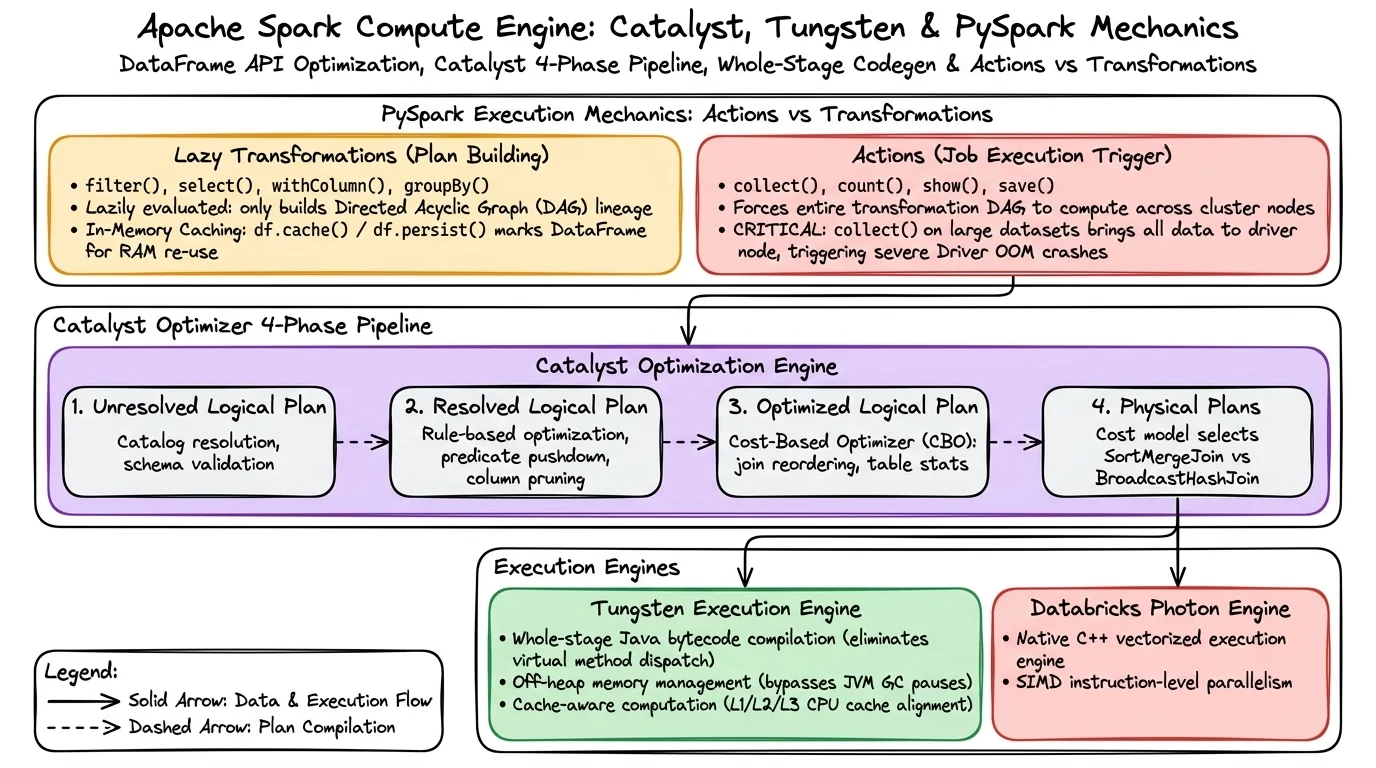
Compute & Optimization
Databricks Compute: Catalyst Optimizer, AQE & Photon
Query Optimization Pipeline, Runtime Adaptive Query Execution (AQE), and Vectorized C++ Execution
4-phase Catalyst query compilation pipeline, runtime re-planning via Adaptive Query Execution (AQE), and execution branching between JVM Tungsten and native C++ Photon.
Key Architectural Pillars
- •PySpark Actions vs Transformations: Transformations (filter, select, withColumn) build an unresolved/resolved execution DAG lazily; Actions (collect, count) force computation and trigger cluster job execution.
- •Action Safety Guardrails: Actions are NOT for performance optimization; executing collect() on large datasets crashes the single Driver JVM with an Out-of-Memory (OOM) error. Caching (cache, persist) is a transformation, not an action.
- •Catalyst & Tungsten Acceleration: DataFrame API outperforms RDDs through automated rule/cost-based plan optimization and Project Tungsten whole-stage bytecode generation over off-heap memory.
#Catalyst Optimizer#AQE#Photon#SIMD#Vectorized Engine#Tungsten Engine
Inspect 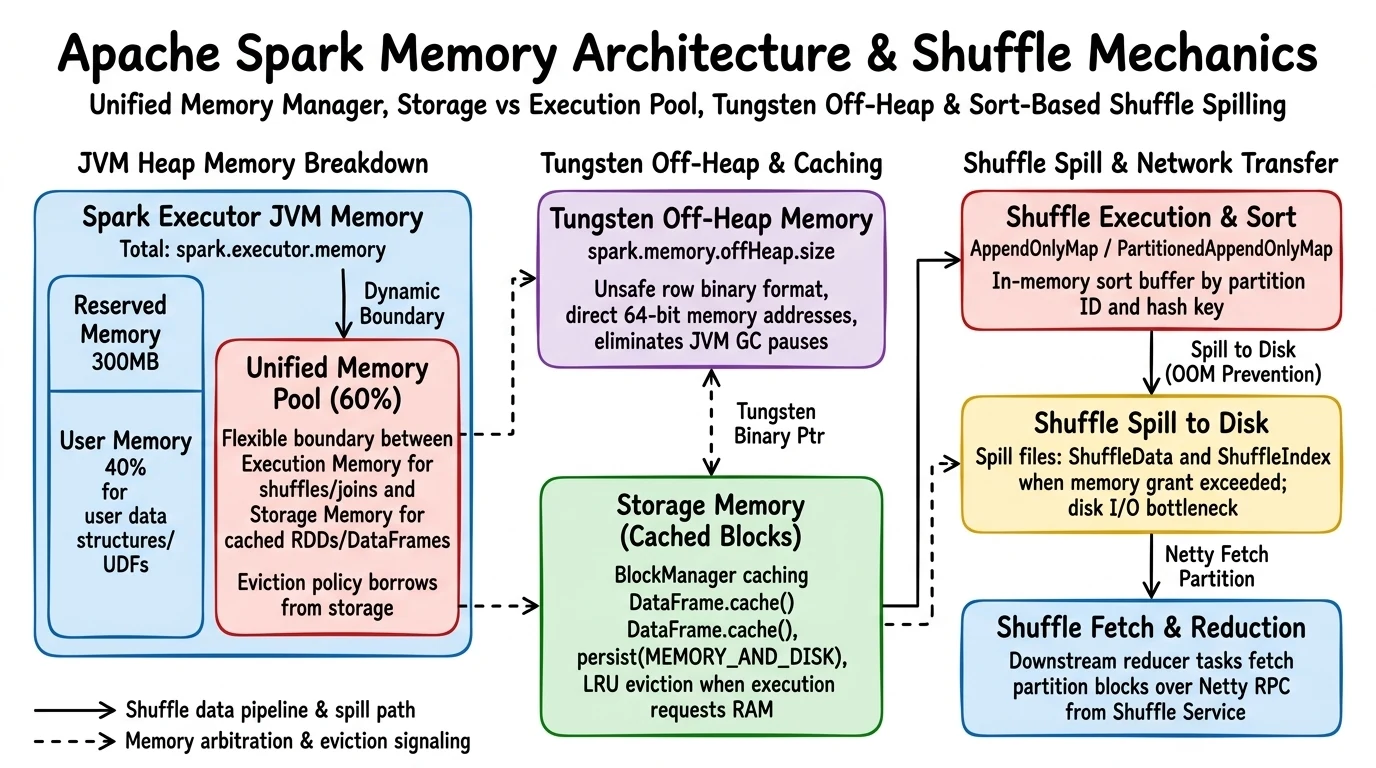
Compute & Optimization
Apache Spark Memory Architecture & Shuffle Mechanics
Unified Memory Manager, Storage vs Execution Pool, Tungsten Off-Heap & Sort-Based Shuffle Spilling
Comprehensive breakdown of Spark executor memory layout and shuffle mechanics. Contrasts JVM on-heap user memory with the Unified Memory Manager (Execution vs Storage dynamic boundary), Tungsten off-heap memory, and the sort-based shuffle pipeline showing memory buffers spilling to disk.
Key Architectural Pillars
- •Unified Memory Manager dynamically shares memory between Execution (shuffles/joins/aggregations) and Storage (cached DataFrames).
- •Dynamic eviction allows execution to borrow memory from storage, evicting cached blocks to disk or dropping LRU blocks when memory grants surge.
- •Tungsten Off-Heap Memory allocates direct 64-bit memory addresses using sun.misc.Unsafe, eliminating JVM object header overhead and GC latency.
#Apache Spark#Memory Management#Unified Memory#Shuffle#Tungsten#Off-Heap#Spill to Disk
Inspect 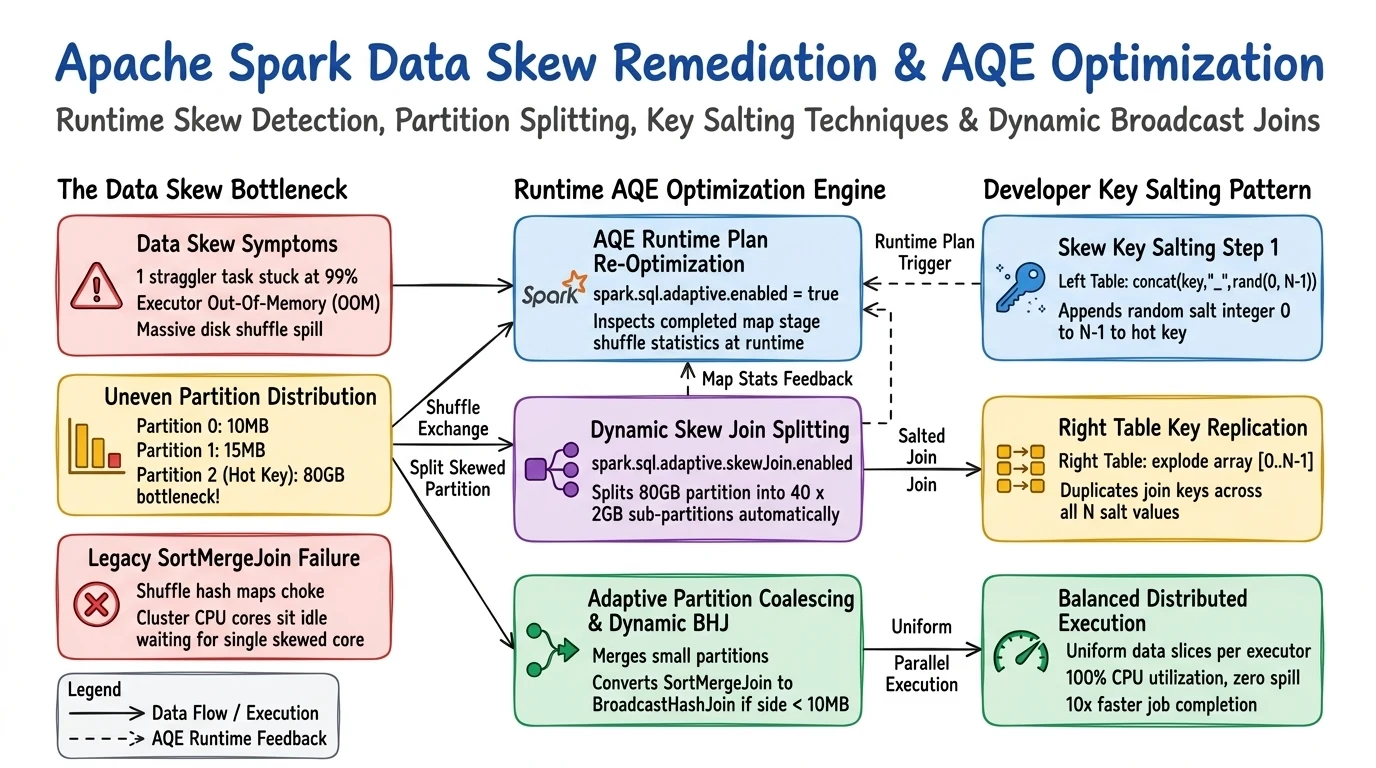
Compute & Optimization
Apache Spark Data Skew Remediation & AQE Optimization
Runtime Skew Detection, Partition Splitting, Key Salting Techniques & Dynamic Broadcast Joins
Comprehensive blueprint resolving the single biggest performance killer in distributed Spark workloads: Data Skew. Contrasts severe skew bottlenecks (99% single-task stragglers, executor OOMs, and massive shuffle spill) with runtime Adaptive Query Execution (spark.sql.adaptive.skewJoin.enabled) that dynamically splits giant partitions into sub-partitions, and developer-side Salted Join techniques that evenly distribute skewed keys across all worker cores.
Key Architectural Pillars
- •Data Skew Bottleneck: Hot join keys (e.g. NULL, 'US', defaults) concentrate gigabytes into a single partition, causing straggler tasks, executor timeouts, and severe disk spill.
- •AQE Dynamic Skew Join Splitting: Spark 3.x inspects completed map shuffle files at runtime, automatically splitting partitions exceeding skew thresholds into balanced 40–128MB chunks.
- •Dynamic Broadcast Hash Join (BHJ): AQE dynamically converts costly SortMergeJoins to broadcast joins at runtime if stage statistics reveal the filtered right-side table is under 10MB.
#Apache Spark#Data Skew#AQE#Adaptive Query Execution#Key Salting#Skew Join#SortMergeJoin#BroadcastHashJoin
Inspect 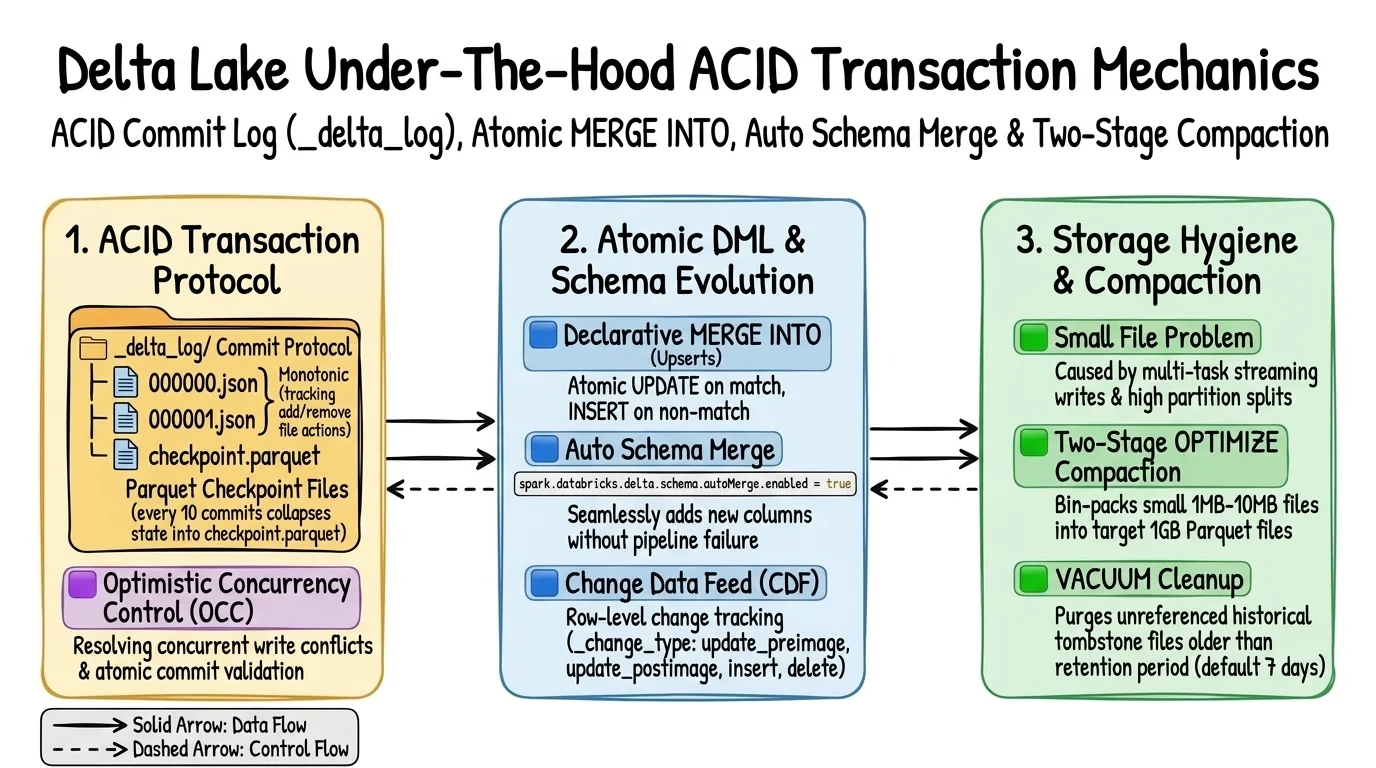
Storage Engine
How Delta Lake Works Under the Hood
ACID Transactions, Transaction Log Protocol (_delta_log), & Liquid Clustering
3-panel under-the-hood mechanism contrasting raw Parquet file limitations with Delta Lake's ACID transaction log protocol, Optimistic Concurrency Control, and dynamic Liquid Clustering.
Key Architectural Pillars
- •Universal Lakehouse Standard: Delta Lake provides ACID transactions, schema evolution, and open cross-engine interoperability (Spark, Synapse DW, KQL, Power BI Direct Lake) on top of Parquet storage.
- •Declarative MERGE INTO & Auto Schema Merge: Executes atomic UPSERT operations; setting spark.databricks.delta.schema.autoMerge.enabled=true allows automatic assimilation of schema changes without write failures.
- •Non-Blocking Schema Evolution: Partitions maintain independent schema metadata in the _delta_log; query engines reconcile schemas at read time and automatically populate missing columns with NULLs without data rewrites.
#Delta Lake#ACID#_delta_log#Liquid Clustering#OCC#Time Travel#CDF
Inspect 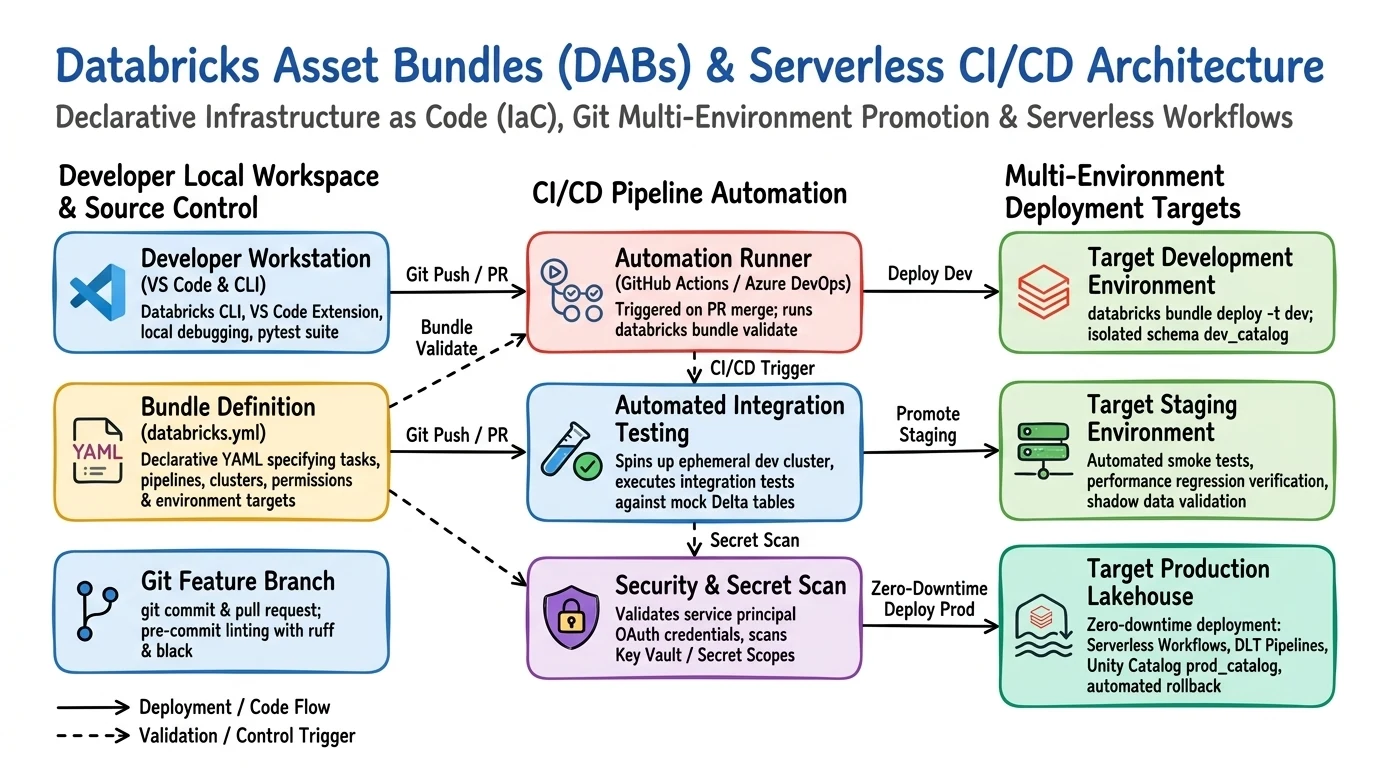
Data Pipelines & Ingestion
Databricks Asset Bundles (DABs) & Serverless CI/CD Architecture
Declarative Infrastructure as Code (IaC), Git Multi-Environment Promotion & Serverless Workflows
Modern enterprise DevOps and Infrastructure-as-Code (IaC) lifecycle using Databricks Asset Bundles (DABs). Illustrates local developer authoring in VS Code with databricks.yml bundle definitions, automated CI/CD validation and ephemeral integration testing via GitHub Actions / Azure DevOps runners, and automated zero-downtime promotion across isolated development, staging, and production Unity Catalog catalogs.
Key Architectural Pillars
- •Declarative databricks.yml Specification: Defines pipelines, notebooks, serverless workflows, cluster configurations, and access permissions in human-readable version-controlled YAML.
- •Shift-Left CI Automation: CI runners trigger `databricks bundle validate`, static code linting (ruff, black), and execute automated pytest suites against ephemeral development clusters before PR merge.
- •Multi-Environment Target Promotion: Enables isolated deployment targets (-t dev, -t staging, -t prod) binding to dedicated Unity Catalog catalogs (dev_catalog vs prod_catalog) and service principals.
#Databricks#DABs#CI/CD#DevOps#Infrastructure as Code#GitHub Actions#Serverless Workflows#Unity Catalog
Inspect 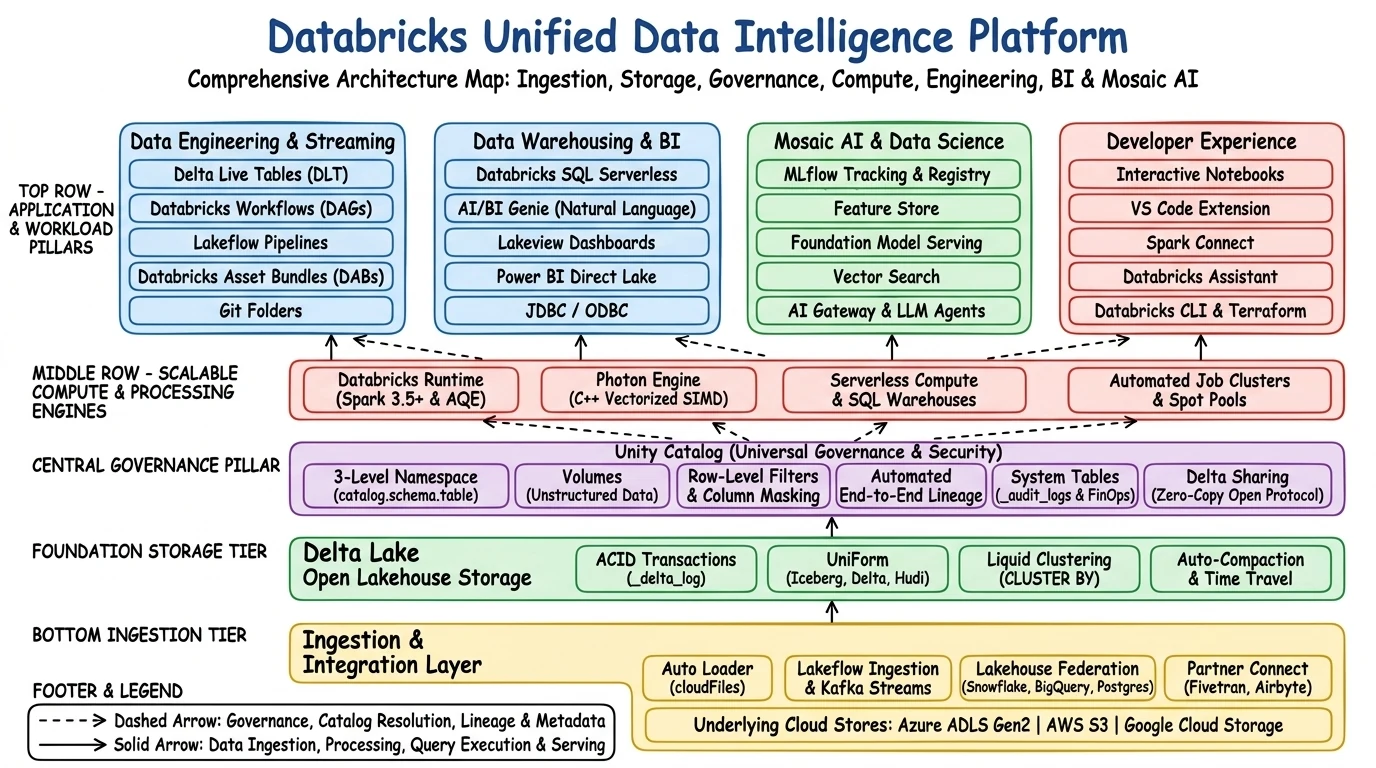
Platform Landscape
Databricks Unified Data Intelligence Platform
Comprehensive Landscape: Ingestion, Storage, Governance, Compute, BI & Mosaic AI
Complete architectural map spanning raw ingestion (Auto Loader, Lakeflow), open lakehouse storage (Delta Lake, UniForm), central governance (Unity Catalog), scalable compute (Photon), and enterprise workload pillars.
Key Architectural Pillars
- •Five horizontal foundational tiers governed centrally by a unified Unity Catalog Metastore.
- •Universal Format (UniForm) provides zero-copy open metadata interoperability across Delta Lake, Apache Iceberg, and Apache Hudi.
- •Native Photon C++ vectorized engine accelerates SQL Warehouses and Spark DataFrames with CPU SIMD registers.
#Lakehouse#Unity Catalog#Photon#Mosaic AI#Delta Live Tables#Serverless SQL
Inspect Production Engineering Standard
6 Rules for High-Throughput Spark Architectures
01
Eliminate Shuffle Spills
Spills occur when execution memory cannot fit in-flight shuffle structures. Size partitions properly (100–200 MB) and balance spark.memory.fraction = 0.6.
02
Broadcast Small-File Joins
Avoid sort-merge joins when joining large datasets with small lookups (<10MB). Explicitly broadcast the smaller table to bypass full stage exchanges.
03
Avoid Row-by-Row UDFs
Python/Scala UDFs bypass Catalyst optimization and force row-by-row object instantiation. Use native Spark SQL expressions or vectorized Pandas-UDFs.
04
Enforce Dynamic Watermarking
Stateful Structured Streaming applications must enforce retention limits with watermarks. Uncapped state expansion triggers OutOfMemory errors.
05
Truncate Long Lineage DAGs
Long lineage graphs overwhelm the Driver JVM call stack. Break long DAGs in iterative algorithms by periodically calling .checkpoint() to disk.
06
Explicit Storage Unpersist
DataFrames persisted via .cache() or .persist() remain in memory indefinitely. Always call .unpersist() as soon as downstream stages complete.